Image by Vertigo3d from Getty Images Signature

Image by Vertigo3d from Getty Images Signature
Explaining The NLP Communication Model: Insights and Issues

NLP stands for Neuro-Linguistic Programming, a method that has been widely discredited as a pseudoscience. Still, it remains a popular topic, with many people seeking explanations of its concepts and critiques of its effectiveness. Developed in the 1970s by Richard Bandler and John Grinder, NLP was inspired in an era where computer programming was an…
🧭 How to Use This Blog
This blog is designed a bit differently. Instead of giving you big ideas and saving the "how" for a product pitch at the end, I like to walk you through the process step-by-step—with practical tools you can actually use. Think of it like a workbook in blog form: hands-on, reflective, and designed to support real insight.
You’ll find:
-
💡 Reflection prompts woven throughout, which you can sit with quietly or journal through—whatever suits your style
- 📝 Exercises to guide you through specific steps, practices, or processes
-
🛠️ Tools and worksheets to help you go deeper——some are free, some are paid
- 📄 Reference sheets for quick, printable overviews of key ideas that go beyond what’s covered in the blog
-
👣 Optional next steps at the end, if you'd like to work with me directly
You can dip in or dive deep. No need to “do it right”—the way you engage is the right way for right now. My goal is to make the ideas doable—not just understandable. (And if you’re overthinking that, hi. You’re among friends.)
NLP stands for Neuro-Linguistic Programming, a method that has been widely discredited as a pseudoscience. Still, it remains a popular topic, with many people seeking explanations of its concepts and critiques of its effectiveness.
Developed in the 1970s by Richard Bandler and John Grinder, NLP was inspired in an era where computer programming was an exciting new frontier. They claimed that all behaviours could be broken down into three fundamental elements: neurological processes (neuro), patterns of language (linguistic), and observable patterns of behaviour (programming). Bandler and Grinder claimed that by altering specific parts of these sequences, individuals could replicate the behaviour and success of 'models of excellence.'
I thought deeply about whether I wanted to update & continue to share this piece on the NLP Communication Model, given my complex relationship with the field. Here’s why I decided to do so.
The Brain’s Bandwidth Problem: Insights from Flow
Imagine that every second, you receive 2 million bytes of information from the world around you. This information comes through your five senses: taste, smell, touch, sight, and sound.
To put that in perspective, hold out your right hand and imagine I’m handing you one piece of LEGO per second. Now imagine I’m handing you 2 million pieces per second. Overwhelming, right?
Your brain feels the same way! According to Hungarian psychologist Mihaly Csikszentmihalyi in his book Flow, our brains can only consciously process 134 bytes of information per second. Out of those 2 million pieces of LEGO, we’re only aware of 134.
So, how does your brain decide which pieces to keep? And how does this filtering process tie into the NLP communication model?

NLP Communication Model: Deleting, Distorting, and Generalising
To decide which LEGO pieces (or bytes of information) to keep, our brain uses cognitive filters. These filters identify the important "LEGO blocks" that build our internal world, while the rest are filtered out through three key mechanisms: deleting, distorting, and generalising.
1. Deleting: What We Don’t Notice
Deletion occurs when our brain selectively focuses on certain aspects of an experience while ignoring others. For example, right now, you might not notice the temperature of the room, the sensation of your feet on the floor, or the sound of traffic outside. Those bytes of LEGO are deleted because your brain is prioritising something else—like the concepts in this article.
2. Distorting: How We Interpret Information
Distortion happens when we transform or interpret LEGO bytes before adding them to our "internal LEGO kingdom." For instance, I was in my early 30s before I realised Tom Petty was singing "I Walk Back Down" instead of "I Won’t Back Down." That simple distortion changed my entire understanding of the song—until I discovered the real lyrics and my internal LEGO world had to adjust.
3. Generalising: Creating Rules from Patterns
Generalisation is when we take one byte—or a cluster of bytes—and apply it as a rule to other situations. For example, after stepping on a blue LEGO piece and feeling the pain, I might generalise that all blue LEGO pieces are painful. Now, I avoid blue LEGO entirely, believing it’s "spikier" than other colours. Even when I see others enjoying blue LEGO, I’m convinced it wouldn’t work for me.
How These Mechanisms Work Together
Deleting, distorting, and generalising don’t work in isolation—they constantly interact to shape how we perceive and interpret the world. They are powered by the cognitive filters that decide which LEGO pieces make it through, and these filters, in turn, are reinforced by the DDGs.
For example, the more blue LEGO I step on, the more my filters:
- Delete any evidence of cool blue LEGO,
- Distort blue LEGO as inherently hurtful, and
- Generalise that I’ll never find a blue LEGO piece that’s right for me.
These mechanisms help us make sense of the overwhelming information around us, but they can also trap us in rigid patterns of thinking if left unchecked.
How These Mechanisms Connect to Schema Theory
The DDG mechanisms are closely linked to schema theory. Schemas are mental structures that help us organise and interpret the world.
- Deleting happens when information doesn’t match our schema and gets filtered out.
- Distorting reflects how we bend new information to fit what we already know.
- Generalising shows how schemas form by turning specific experiences into broad rules.
When new information challenges our schema, we either accommodate (change the schema) or assimilate (adjust the information to fit). This process helps us navigate a world of overwhelming information but can also reinforce unhelpful patterns.
What Informs Our Information Filters?
So, what are the filters that shape our perception?
The filters that decide which LEGO bytes make it into our internal world include:
- Language: The specific words and grammar patterns we use.
- Memories: Experiences from our life and education.
- Decisions: Choices we’ve made in the past and present.
- Values and Beliefs: Formed as a result of those decisions and experiences.
- Metaprograms: Unconscious filters that influence how we sort and prioritise LEGO bytes.
At any moment, we are only experiencing a subjective replica of reality—our own internal LEGO kingdom. This kingdom is built from a tiny fraction of the available LEGO blocks (information bytes) and is always a limited version of the true external experience. That’s why two people can recall and interpret the exact same event in completely different ways.
Organising the Overload: How Your Brain Groups Information
How Do We Group Information?
As the LEGO bytes pass through our filters, our brains organise them into categories or chunks to make sense of the information.
The sorters in our internal LEGO kingdom can only focus on seven chunks at a time—give or take two. Some kingdoms can handle up to nine chunks, while others may only manage five. This concept is based on the psychological principle of chunking.
The 134 bytes of LEGO are grouped into these seven chunks, which we use to construct our current picture of the world. This process is how we create meaning from the vast stream of information.
From Chunks to Actions
Once we’ve built our internal LEGO kingdom, we gaze upon it, and the process unfolds:
- It creates a feeling.
- That feeling leads to a change in our physiology (body).
- Finally, it drives our actions and behaviour.
George Miller’s Law of Chunking (1956)
The process of grouping information into chunks is rooted in George Miller’s theory of short-term memory capacity. Chunking allows us to simplify and organise the vast amount of information we process every moment.
- Filters help determine which bytes of LEGO (information) are prioritised for chunking.
- Chunks represent manageable categories of information, limited to about seven at a time—give or take two.
- Interpretation happens as we use these chunks to build a meaningful internal representation of the world.
Modern neuroscience continues to support the core idea of Miller's Law of Chunking, but refines it from a deeper understanding of the mechanisms of working memory. While Miller suggested a limit of about 7 chunks (plus or minus 2), current research illustrates that this number varies based on factors like individual differences or task complexity.
From Overload to Mastery: How Chunking Simplifies Learning
Think back to when you learned to drive.
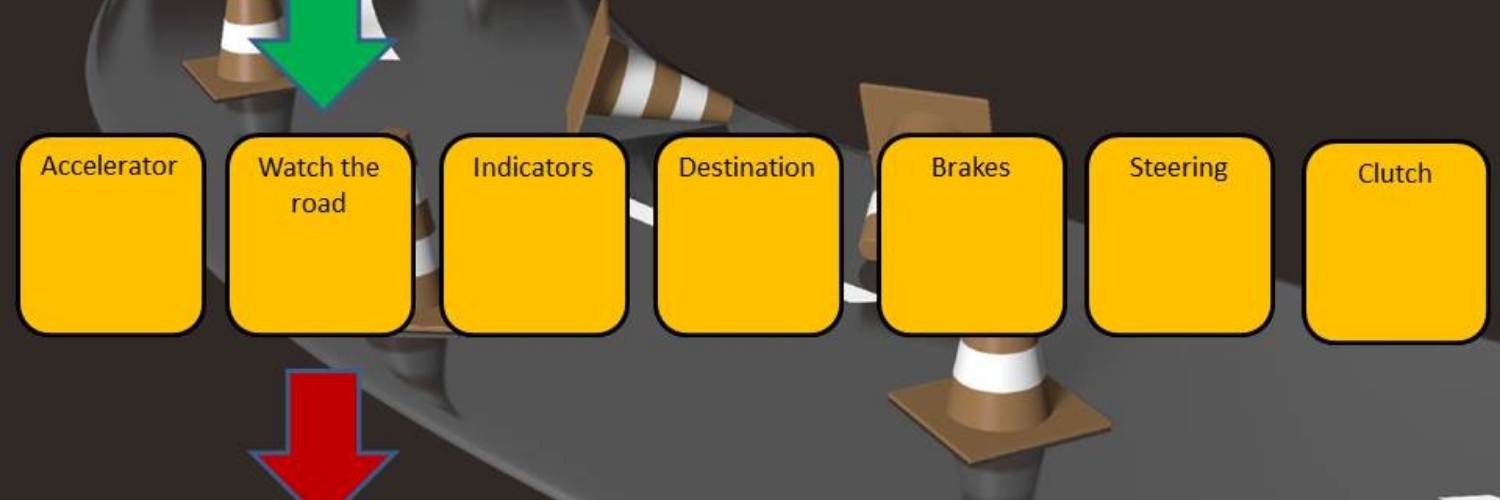
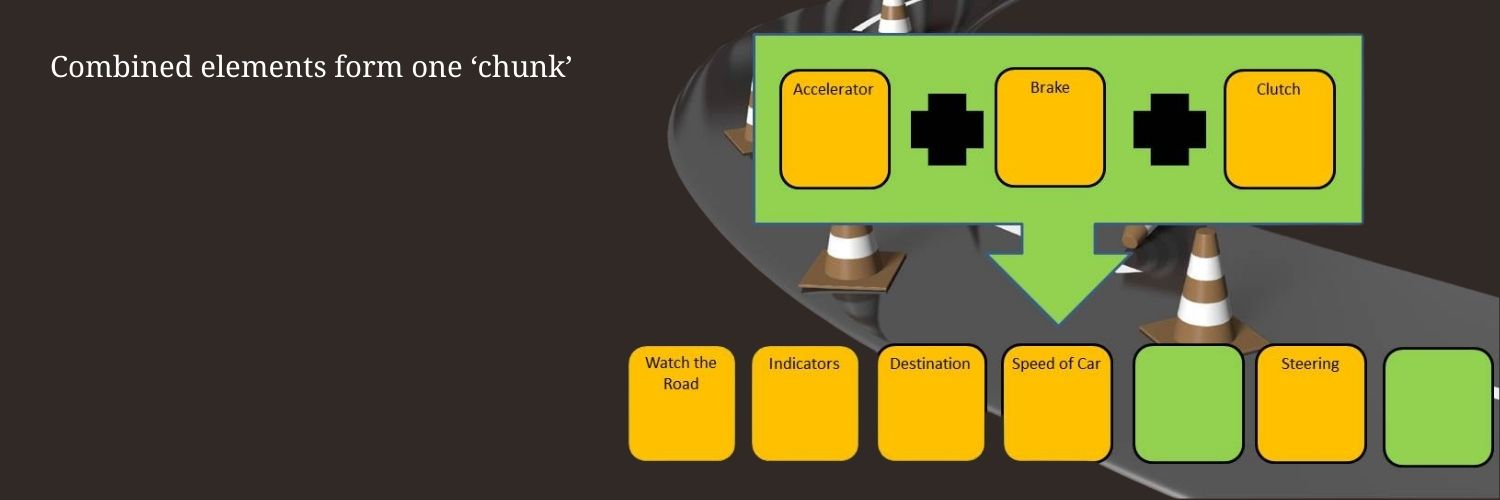
At first, your brain’s sorters allocated seven chunks to manage tasks like using the accelerator, watching the road, indicating at corners, remembering your destination, using the brakes, steering, and handling the clutch. Each of these chunks demanded your full awareness to notice and process the right "LEGO bytes."
Now imagine it starts to rain. Suddenly, there's a new category to manage: adjusting to wet conditions. With eight chunks to process, you might begin missing crucial information you were already tracking.
Over time, as you became familiar with driving, your sorters started combining chunks into larger, more efficient categories. For example, the accelerator, brake, and clutch became one chunk: "the speed of the car." This shift freed up space in your working memory for additional complexity.
Years later, driving becomes second nature. You can now steer, navigate, maintain spatial awareness, and even drink coffee, sing, or critique other drivers out loud—all thanks to the efficiency chunking brings to your internal LEGO kingdom.
From Inherited Patterns to Intentional Living
This is where the power of the NLP communication model comes into play. Understanding how you create your internal world gives you the ability to examine the filters you use and to understand how others, like your partner, build their internal world. And that is the key to shaping not only your personal experience but also your shared reality.
What does this mean? You are in charge.
Sometimes, the filters we inherit or adopt limit us, shaping a world built from someone else’s values, beliefs, and experiences. Over time, these filters can lead us to recreate internal worlds and relationships that don’t reflect who we truly are. For example, Roles—the parts we play in relationships—and Realms—the influences that shape our experiences—are deeply tied to these inherited filters.